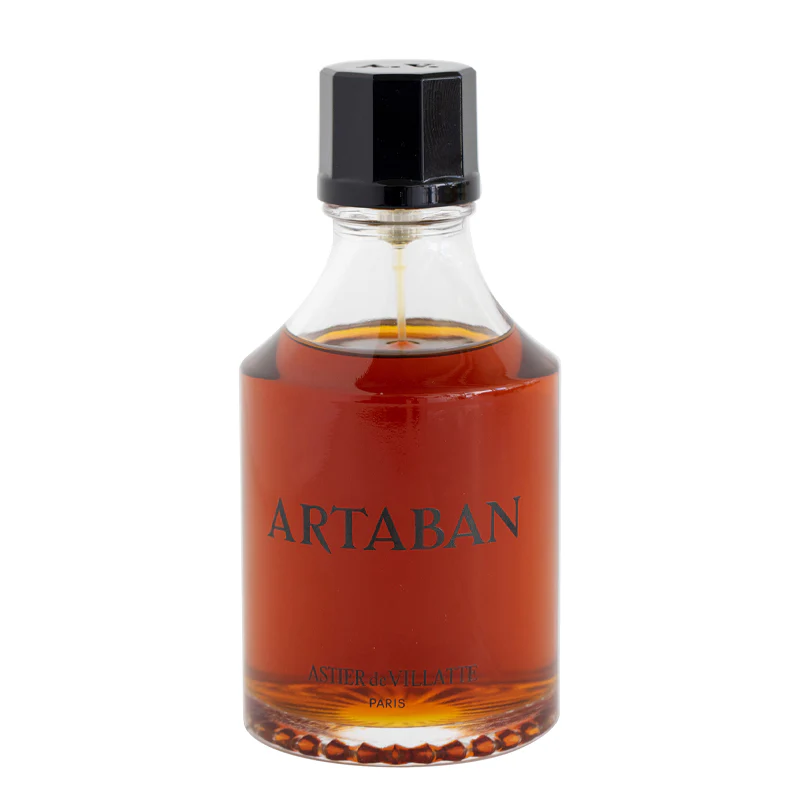
Artaban - Eau de Parfum
Hailed by the historian Pliny the Elder for its incredibly prodigious formula, containing no fewer than 24 aromas and only the finest and richest (serichatum, costus, cassia, styrax…), imported at great expense from far-flung lands, this “royal perfume,” originally created for the Parthian Kings, was worshipped by wealthy Romans. They could not get enough of it, drenching themselves in it at any opportunity, as dictated by the fashion of the times.
Reinterpreted by Dominique Ropion, Artaban is a pure, telluric and wild concentrate of the wonders of the plant world. We delight in its heady scents: bittersweet marjoram with its small, green, rounded leaves exhaling a delicious aroma; cardamom, with its fresh, spicy, aniseed tang, like a bracing gust of wind; cistus labdanum, whose white flowers adorned with crimson dots gave it the name “tears of Christ”; sweet, vanilla amber, with its scent of incense; and warm cinnamon, humanity’s most ancient spice.
Le Parfums Historiques: These perfumes are the result of a meeting between Ivan Pericoli and Benoît Astier de Villatte, the creators of Astier de Villatte, Dominique Ropion, perfumer, and Annick Le Guérer, perfume historian, anthropologist and researcher. All of them driven by the same passion: to restore the prestige of three mythical and magnificent fragrances — Le Dieu bleu (Egyptian kyphi), Artaban (the Roman “royal perfume”), Les Nuits (the perfume of George Sand) — by reconstituting as closely as possible the formulas of the time according to the regulations of today’s perfumery.
Star perfumer at IFF, Dominique Ropion pulled out all the stops in the reconstitution of these three formulas, a perilous exercise considering their richness and complexity. His close collaboration of more than twenty years with Annick Le Guérer was the starting point of the project. The historian provided him with precise documents for the first two perfumes, right down to recipes and the proportions of each ingredient, as well as dregs from the bottom of a travel phial of George Sand’s perfume, entrusted by one of her descendants, Christiane Sand. Ingredients which no longer complied with and are prohibited by current perfumery standards had to be adapted or replaced with substitutes. State-of-the-art technology and innovation made this artistic and technical challenge possible.
These three fragrances were produced at the Atelier du Parfumeur in Grasse using 100% natural raw materials, essences and concretes, as well as new aromas.
Product Information
Product Information
Shipping & Returns
Shipping & Returns
Description
Hailed by the historian Pliny the Elder for its incredibly prodigious formula, containing no fewer than 24 aromas and only the finest and richest (serichatum, costus, cassia, styrax…), imported at great expense from far-flung lands, this “royal perfume,” originally created for the Parthian Kings, was worshipped by wealthy Romans. They could not get enough of it, drenching themselves in it at any opportunity, as dictated by the fashion of the times.
Reinterpreted by Dominique Ropion, Artaban is a pure, telluric and wild concentrate of the wonders of the plant world. We delight in its heady scents: bittersweet marjoram with its small, green, rounded leaves exhaling a delicious aroma; cardamom, with its fresh, spicy, aniseed tang, like a bracing gust of wind; cistus labdanum, whose white flowers adorned with crimson dots gave it the name “tears of Christ”; sweet, vanilla amber, with its scent of incense; and warm cinnamon, humanity’s most ancient spice.
Le Parfums Historiques: These perfumes are the result of a meeting between Ivan Pericoli and Benoît Astier de Villatte, the creators of Astier de Villatte, Dominique Ropion, perfumer, and Annick Le Guérer, perfume historian, anthropologist and researcher. All of them driven by the same passion: to restore the prestige of three mythical and magnificent fragrances — Le Dieu bleu (Egyptian kyphi), Artaban (the Roman “royal perfume”), Les Nuits (the perfume of George Sand) — by reconstituting as closely as possible the formulas of the time according to the regulations of today’s perfumery.
Star perfumer at IFF, Dominique Ropion pulled out all the stops in the reconstitution of these three formulas, a perilous exercise considering their richness and complexity. His close collaboration of more than twenty years with Annick Le Guérer was the starting point of the project. The historian provided him with precise documents for the first two perfumes, right down to recipes and the proportions of each ingredient, as well as dregs from the bottom of a travel phial of George Sand’s perfume, entrusted by one of her descendants, Christiane Sand. Ingredients which no longer complied with and are prohibited by current perfumery standards had to be adapted or replaced with substitutes. State-of-the-art technology and innovation made this artistic and technical challenge possible.
These three fragrances were produced at the Atelier du Parfumeur in Grasse using 100% natural raw materials, essences and concretes, as well as new aromas.